ReflectionsJuly 28, 202611 min read
There Is Thunder Already, When Does the Rain Come?
Some words carry a long way and never soften the ground. The real work is usually quieter, slower, and leaves a mark that outlasts anything that was said.
 Le PhamTinkerer · CEO · Hope Dealer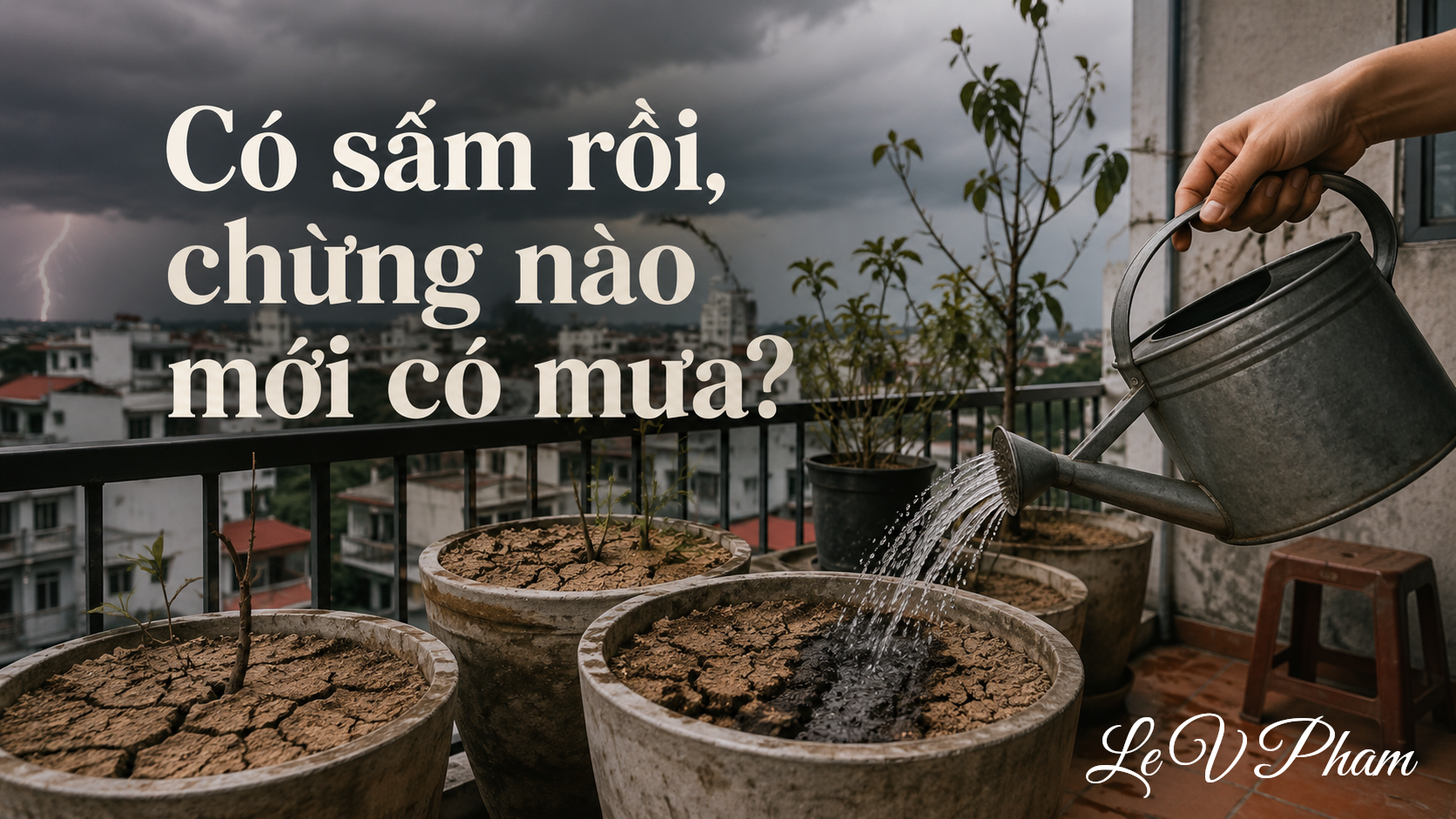
Someone stands in the middle of the room, a finger moving from one place to the next. This person has not done it. That one did not finish. This should have been done yesterday. If you had given that to me it would not have come to this. The sentences roll on, they sound reasonable, sharp, enough to make a few heads nod. And the desk in front of them is still a mess, the glass still sitting at the edge, their own share of the work untouched. Sometimes I wonder why the thunder in a room always arrives faster than the rain. Thunder needs one mouth and a few minutes of irritation. Rain needs time, needs effort, needs somebody willing to bend down and finish the thing. The distance between the two looks short, from lips to hands, and plenty of people never make the trip.
Thunder has a pull of its own. It gives the speaker the feeling of taking part, of caring, even of carrying the hardest part. Naming what is wrong with a task sometimes gives a pleasure close to having fixed it. Pointing out that someone else is slow makes you feel fast. Criticising a leaking roof makes you feel the hammer already in your hand. And the mind quietly enters the words on the credit side of the ledger, even though not one drop has fallen out there. That is where the trap is. It is not that people are deliberately lazy. Often they have simply mistaken sound for movement. A long discussion, a few well-placed complaints, an analysis that hangs together nicely, and inside you feel as tired as if you had done something big. The tiredness is genuine. It is only a pity that the ground is still dry.
Out in the world, thunder has many voices. The irritated one: how is something this simple still not finished? The weary one: I have said it a hundred times and nobody does anything. And the softer one that lingers like drizzle: this person is irresponsible, that one is not perceptive, the situation is not favourable, the weather is not helping. Too hot, cannot work. Too cold, leave it for tomorrow. Too hungry, no strength. Too full, sleepy. The first two sound like reasons, and by the third a slightly embarrassing truth shows through: anyone who wants to avoid something can sew a raincoat out of any scrap of cloth. Put it on and stand there dry, watching other people wade. And with a little more skill, point out to them where the water is deepest. I say this quietly, because that coat is not rare. Most of the time it is already hanging up inside each of our heads.
The opposite of thunder is the people who bring rain and make little noise. They are not necessarily faster, better or more noble. They simply begin. The chair is crooked, so they straighten it. The line is wrong, so they fix it. The call is awkward, so they dial the number. The task is unclear, so they ask until it is clear and then keep plodding along. Watching them is often unremarkable, because real action does not know how to pose. It is clumsy, slow, sometimes done two or three times over. A rainstorm does not fall to a speech either. One drop hits the tin roof, the next pools on the veranda, another lands right in the basin someone put out. Scattered like that, and after a while the yard is wet. Work is the same. It does not need to announce its usefulness. You look up and the desk is clear, things are moving, someone else has room to carry on. Rain does not compete with thunder. Rain only falls.
There is one very ordinary detail that says the whole distance for me: saying go and wash the rice takes about one breath. Say it and it is said. Doing it means fetching the rice, measuring it out, adding water, working it with your hand, pouring it off, and repeating. The grains do not get clean at the speed of the sentence. The water does not clear because the person standing next to you explains it well. A tiny thing, so familiar that hardly anyone notices, and it strips bare the difference between understanding and doing. Understanding arrives as a sentence. Doing arrives as a movement. A sentence can be out in an instant, a movement has to pass through the slowness of the body, through a little reluctance, a little fatigue, through the attempt that was not skilful enough. Which is why saying the right thing is never as hard as living up to what you just said. Saying calm down takes two seconds. Holding your tongue while you are angry can take years. Saying do not judge people is easy. Stopping a piece of gossip exactly when it is at its most delicious is the hard part.
From there I noticed that hunting for other people's faults does not only wear them out. It takes time from the person doing the hunting. Every minute spent pointing is a minute that hand is doing nothing. Every dig into someone else's shortfall is a moment your own share of the work sits untouched at the edge of the table. Some people know every fault in the room, who was late, who forgot, who talked and did not act, and cannot remember what they themselves put down today. Other people's faults are like clouds, easy to see, just look up. Your own sit right under your feet, and you have to bend down to meet them. Bending down is not impressive. Bending down also risks noticing that your own sandals are muddy, that the corner you are responsible for is leaking too, that you and the other person are not as far apart as that criticism suggested. That is the uncomfortable part. Which is why looking outward is always lighter work than examining your own share.
I do not think silence is automatically good, and I do not think every criticism is wasted. Sometimes thunder announces real rain, and a sentence said at the right moment saves a whole group from going the wrong way. Some people speak while they work, and their words are not hollow because there are footprints behind them. The issue is not the volume. It is what comes after the sound. Is there a hand that helps fix the thing after the feedback. Is there a step forward after the complaint. After the leaking roof has been pointed out, does the speaker hold the ladder, pass up the tile, or step back to see who falls. Words with work behind them are like thunder that pulls the clouds in: you hear it and you know the weather is about to change. Words that only prove you were right rumble once and go out, leaving the air heavier than before. Being right without putting a hand in is often just a clean shelter for indifference.
The hardest part is probably realising that the thunder is not only other people. It can live inside a very reasonable remark, inside the click of the tongue that says it should have been, inside the impatience of watching someone do something not quite the way you wanted. Take your eye off it and criticism runs ahead while your hands amble along behind, until they lose the trail entirely. There is a crude method that works: whenever you are about to list what someone else has not done, put beside it one thing you could do right now. Not to take on everything, not to perform generosity. Only so the words carry the weight of one drop of water. If you cannot help, at least do not turn helplessness into a speech. If it needs saying, say it precisely. If you have said it, do part of it. If you have done nothing, lower your voice a little. Three simple things, and the moment there is real work in front of you, you find your hands hide faster than your mouth.
There will still be rooms full of noise, conversations full of the faults of whoever is absent, days when everyone knows what has to be done and nobody wants to be the one who starts. I am not hoping for thunder to disappear. A sky with no thunder in it can be stifling too. I only hope that after the rumble one drop falls, and then another. Slow is fine. Clumsy is fine. One small thing done properly is cooler than ten correct sentences left lying there. The ground does not remember who described the drought best. The ground softens when it meets water. And thunder, after rolling for a while, goes out through the door, leaving behind the table, the glass, and the work still unfinished. Outside on the veranda the clouds have come in. Whether it rains, nobody knows yet. But at least someone has stopped pointing and bent down to work.

Tinkerer in financial economics, serial entrepreneur, and professional stumbler. 99% failures, 1% still here.