ReflectionsMay 9, 202610 min read
The Things I Left Behind to Live More Clearly
Not about minimalism. About the specific things — habits, relationships, identities — I quietly stopped carrying, and what it felt like when they were gone.
 Le PhamTinkerer · CEO · Hope Dealer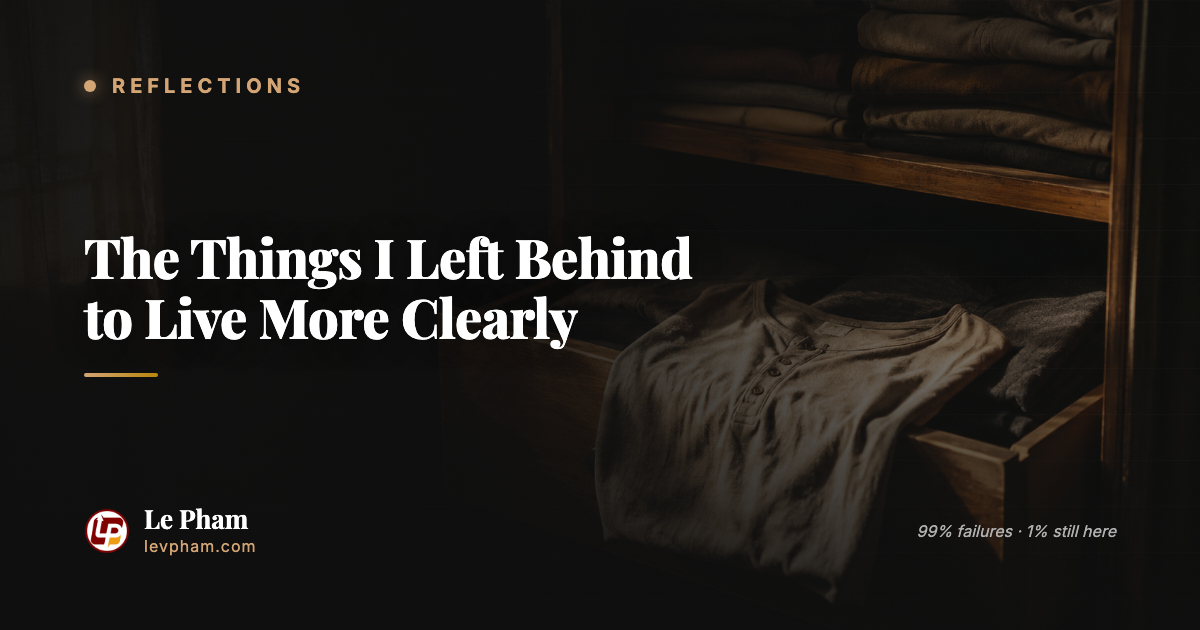
One morning I opened the wardrobe and stood there in front of the drawer with no idea what I wanted to wear. Old shirts, shirts I was given, shirts I have never once put on, all shoulder to shoulder like a reunion nobody asked for. I grabbed a familiar one and closed the door, and it felt like putting a whole section of memory away with it. That feeling came back for years, and not only with clothes. It came back with everything I had decided I could not live without.
Everyone talks about priorities, about filtering, about focusing on what matters. But stand in the middle of a hundred small things that have piled up around you, the unread books, the unanswered messages, the invitation you did not dare turn down, and you find that letting one go is nothing like crossing an item off a to-do list. I asked myself once: am I keeping all this because I am afraid of running short, or because I am afraid of the empty space, of that missed step when there is nothing left to hide behind?
Back when I was leading a team, the habit of hoarding every half-finished relationship cost me more than it gave. One day I understood that not everyone who walked with you for a while needs to stay to the end. Every conversation that did not fit, every night I showed up at a table of beers just to save face, only left me feeling more of a stranger to myself. Fewer friends, but real ones, is lighter. You lose a pile of noise and you keep a little quiet.
I used to carry a lot of plans at once, too. Whatever I did, I was afraid of falling behind. This person took another course, so I signed up for one. That person started a new project, so I opened the laptop and started too. At some point the tasks did not add up to achievements, they added up to loose pieces that would not fit together. The things I was holding turned around and held me.
Giving something up is not always a grand act. Sometimes it is just turning off email notifications, not opening the chat app outside the hours that need it, saying no to an invitation you already know will not be fun. Sometimes it is learning to put down a half-read book when you do not actually want to read it, instead of pushing through to keep the title of someone who reads a lot. I used to tell myself stories: you bought it, so finish it. Say yes to whatever anyone asks and sort it out later. And then I would forget which of those motives had tired me out first.
I remember an evening wandering through the night market in Can Tho, an iced coffee in my hand, my head circling a plan I had just cancelled. My stomach felt lighter, but I also missed the feeling of having something to do. The fear of empty time clung to me like an old winter coat from Canada: the cold is gone but you keep it on you, because you were once afraid of the wind. To drop a habit you sometimes have to accept that for a while you will not know what to do with your hands.
When it is enough, it is enough
These last few years, working alone with AI and automation, the rule has become clearer: the longer you hold something, the more it snags. When I still had the company I carried every role there was. The one who chased the deadline, the one who smoothed things over when there was conflict, the one who absorbed all the pressure when the cash ran thin. In that seat I believed every responsibility I picked up was indispensable. Most of them were just the habit of thinking I was not good enough yet.
Now, working alone, nobody forces me to be excellent at everything. I can take things off the pile without guilt. Some days I only need to finish one small thing, then clear away the noise and give the time to my family, to a quiet coffee, to a few pages of a book that does not need finishing. Not everyone loves the minimal life, but I think knowing when to stop saves you from a longer kind of exhaustion than adding another stretch of road ever will.
I used to keep a year of chat history, never delete a file, remember every friend's birthday. Small things that gathered into a heavy backpack I carried on my mental shoulders all the time. When I started letting go, deleting the memories that had passed, keeping only the messages that mattered, learning to forget the old reminders, my head cleared a little. Even allowing myself to forget a birthday was a kind of release, instead of playing the man who remembers everything. I would rather know the memes than have someone's date of birth memorised. It sounds odd, but at least I am living closer to the truth of myself.
Not every letting go is easy. Sometimes the memory of a person, a project, a habit keeps circling like a cricket late at night. But I learned something: peace is not in the pile of things you keep. It is in being brave enough to release a few things that used to be the centre of yesterday. Release a little, and you see yourself more clearly in the mess you once thought you could not do without.
These days I do not anchor myself to being good at everything, do not chase the crowd, do not hold on to half-finished conversations out of a fear of being forgotten. I have left behind goals that no longer mean anything, parties I attended only to be seen, plans that stopped being wanted a long time ago. There is more empty space in my life now, and in that emptiness I am more myself.
There is something light about waking up and not having to police a hundred notifications, not being nagged by a book left half-finished. I ask one question now whenever I want to add something to my life: do I actually need this, or am I only afraid of missing out? Most of the time the answer is no.
I do not think everyone needs to drop as much as I did. But look around at what you are holding and count how much of it truly matters. How much of it is a draft, a shelter for a few days, that you have still not been willing to release?
Sometimes I go back to that drawer and notice a few old shirts have gone. The wardrobe is emptier and my head is clearer. Instead of keeping it full, I leave room for what I do not yet know is coming. What about you, is there something you held on to for too long that turned out to be lighter the moment you let it go?

Tinkerer in financial economics, serial entrepreneur, and professional stumbler. 99% failures, 1% still here.